
Warren Buffett is 1 of the really number of investors to have managed to compound returns at a 20% yearly normal for much more than 50 decades.
Any individual can be successful more than a 5-10 yr time period, but the true examination is irrespective of whether you can maintain heading for ten years right after decade, and Warren Buffett’s Berkshire Hathaway (BRK.A) (BRK.B) is 1 of the uncommon exceptions to have obtained that:
| Berkshire Hathaway | S&P 500 (SPY) | |
| Compounded Annual – 1964-2020 | 20.% | 10.2% |
| Over-all Get – 1965-2020 | 2,810,526% | 23,454% |
So, when he talks, we pay attention.
In present-day report, we search closer at his solution to authentic estate investing. Around the many years, he has typically reviewed why he hardly ever purchases genuine estate, but extra a short while ago, he has manufactured huge investments in the REIT sector (VNQ).

Under we emphasize 5 reasons why Warren Buffett favors REITs about private house investments:
Reason #1: No Aggressive Gain
In a shareholder assembly many years in the past, Warren Buffett clarifies that they are not equipped to compete with buyers who focus in true estate investing.
The fascinating matter right here is that again then Warren Buffett by now had invested millions into serious estate, had significant assets as a result of Berkshire, and Charlie experienced made his initial fortune in real estate.
Even then, they felt that they couldn’t contend with REITs and other LPs that specialised in true estate investing and experienced an informational edge more than them.
Below you need to check with oneself: If Warren and Charlie can’t contend in the true estate place, can you?
A ton of personal investors consider that just after seeing a several YouTube films and buying a true estate investing class from an on-line expert, they’re very well prepared to turn out to be real estate investors.
In truth, most investors are overconfident and overestimate their qualities. Warren Buffett is very reasonable about his constraints and understands that unless you are 100% centered on serious estate, you happen to be unlikely to obtain superior success investing in it.
Rationale #2: Deficiency of Mispricing
Rather linked to cause #1, if you are not fully dedicated to genuine estate, you are not likely to locate mispriced alternatives.
Warren Buffett describes that mispricings in serious estate are uncommon. The market is somewhat efficient at pricing chance because most traders are extended-term oriented.
On the other hand, mispricings are far more frequent in the inventory market place simply because most buyers are brief-expression-oriented and brief to panic when they see their stock drop in benefit.
Warren thinks that if you are an lively investor, you’re extra probable to obtain greater promotions in the inventory industry, together with REITs, than in personal real estate.
Which is what he mentioned many years back and it is nicely mirrored in present day sector.
Appropriate now, housing is red warm, and professional authentic estate is providing at historically reduced cap costs. The charges reflect the extremely-small fascination fee ecosystem that we dwell in.
Even then, the REIT sector is these days seriously mispriced. A lot of REITs, including blue-chip names like W.P. Carey (WPC), Realty Cash flow (O), and Nationwide Retail (NNN) are down by 20-30% even as their underlying attributes are far more important than at any time before.
That is a superior possibility.
Rationale #3: Corporate Tax Downside
Berkshire Hathaway is structured as a corporation and it’s liable to corporate taxes.
Charlie and Warren clarify that this puts them at a major downside relative to REITs, which are exempt from company taxes.
If you gain a 6% yield on a property, the REIT is still left with 6%, but Berkshire is still left with a lessen gain because of to taxes.
Even then, Berkshire has made REIT investments, which are much more tax economical mainly because REITs only pay back out 50%-70% of their cash move in dividends, and the relaxation is retained at the REIT stage and not taxed. In addition, REITs have a better advancement/appreciation part than personal real estate, which effects in reduced corporate taxes.
Purpose #4: Management And Scalability
In an interview in the course of the great financial disaster, Warren Buffett clarifies that if he experienced a way to successfully control serious estate, he would load up on one-household properties.
A whole lot of traders make t
he oversight of assuming that actual estate is a passive investment decision when in actuality it can be management intensive.
You are working with the dreaded 3 Ts: Tenants, toilets, and trash.
Could Warren Buffett employ the service of a assets administration enterprise? Sure, he could. In truth, he would get a considerably better offer than you or me if he did that.
On the other hand, the difficulty with property administration companies is that their service fees eat into your profitability, but even extra importantly, their passions are not aligned with yours. Acquiring a assets and handing the keys to a house supervisor is the equal of buying an externally-managed REIT, which we all know, is hardly ever a good idea owing to conflicts of interest.
With classic REITs, Warren Buffett will get qualified administration that is nicely aligned with shareholders and enjoys significant economies of scale.
You also can quickly deploy funds in a number of clicks of a mouse, which can make it quick to scale your investments over time.
Cause #5: Options are in REITs Now
Warren Buffett is a worth trader.
He desires to invest in significant-quality property at a price cut to honest benefit.
But as famous before, the personal true estate industry is at this time pink warm. With the exception of a couple challenged sectors (business, malls, and so forth.), you might be not likely to come across discounted options. The demand for personal true estate is better than at any time prior to because of to the ultra-minimal fascination prices.
Even then, lots of REITs are nowadays priced at historically minimal valuations, and not amazingly, that’s what Warren is getting. Down below we highlight just one of his beloved REITs:
Shop Cash
Berkshire Hathaway 1st purchased shares of Keep Cash (STOR) back in 2017, and lately, they doubled down.
As a result, they now possess nearly 10% of the fairness:

In accordance to an interview of Chris Volk, CEO of Retailer Money, it is really Warren Buffett that was behind this financial commitment. You can skip to the 8:55 mark to study far more about Warren Buffett’s financial investment in Keep:
What is actually so specific about Store Cash?
In shorter, STOR has a special system that generates better returns with decreased danger than what Berkshire could obtain on its own. We discuss this method in element in a separate report so we will not likely go into the facts in this article, but its approach has persistently led to significant outperformance relative to its shut peers, and this is probable to continue far into the foreseeable future:
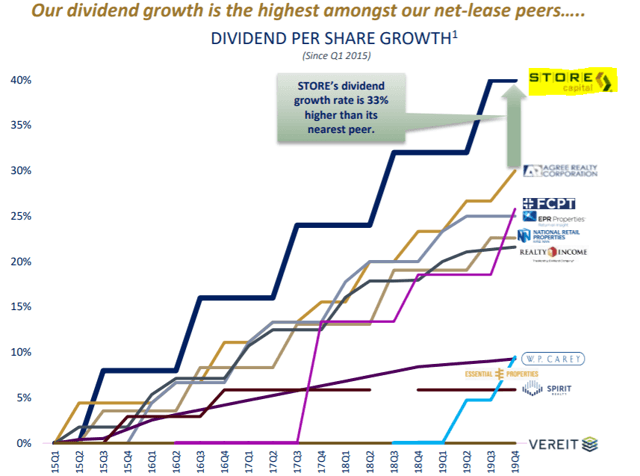
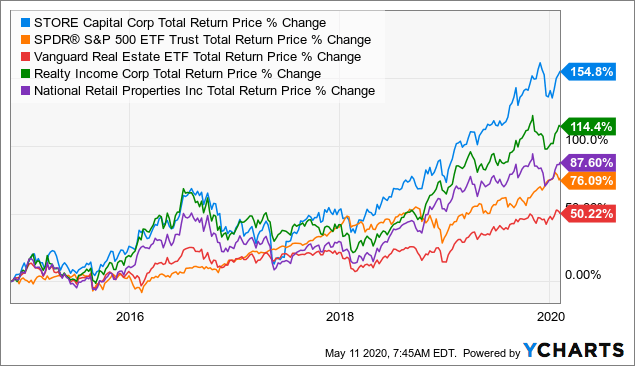
Even then, STOR has been priced at an extremely lower valuation above the earlier 12 months. It can be nevertheless ~15% lessen than prior to the pandemic, and that is in spite of hiking its dividend by 3% in 2020 and guiding for history-superior hard cash move in 2022.
You simply just are unable to locate this variety of prospect in the non-public true estate marketplace and that’s why Warren Buffett favors REIT investments.
These days, there are ~25 identical REIT chances in which we are investing at Significant Generate Landlord.